Balancing Data Utility and Individual Privacy: A Comparative Analysis of Zero-knowledge Proofs and Differential Privacy in AI-driven Ecosystems
Abstract
Artificial intelligence (AI) ecosystems increasingly depend on large-scale data collection and analytics, but this intensifies the privacy-utility tension and exposes individuals to inference and re-identification risks. This paper comparatively analyzes two leading privacy-preserving technologies Zero-knowledge proofs (ZKPs) and differential privacy (DP) to clarify where each is most effective and what trade-offs they impose in AI-driven environments. ZKPs (including zk-SNARKs and zk-STARKs) enable parties to verify claims about data integrity or computational correctness without revealing the underlying sensitive data, making them suitable for verification-heavy workflows such as identity assertions, transactional compliance checks, and blockchain-adjacent systems. DP, in contrast, provides a formal privacy guarantee by adding calibrated noise to datasets or query outputs, thereby limiting privacy leakage while preserving useful aggregate patterns for analytics and model development. Using a comparative analytical approach across representative contexts (healthcare analytics, financial services, and AI model training), the results indicate that DP is more effective for statistical reporting, data sharing, and federated learning scenarios, whereas ZKPs provide stronger guarantees when the primary requirement is trustless verification and auditability. The analysis further finds that neither technique fully addresses the complete spectrum of privacy requirements alone. Accordingly, the paper recommends a hybrid privacy architecture that combines ZKPs and DP (optionally alongside complementary cryptographic methods such as homomorphic encryption) to deliver scalable, regulation-aligned privacy governance for modern AI ecosystems.
References
D. Froelicher, J.-P. Hubaux, J. S. Sousa, J. R. Troncoso-Pastoriza, “Drynx: Decentralized, secure, verifiable system for statistical queries and machine learning on distributed datasets,” IEEE Transactions on Information Forensics and Security, vol. 15, pp. 3035–3050, 2020.
T. Antignac and D. Le Métayer, “Privacy architectures: Reasoning about data minimisation and integrity,” in Security and Trust Management, S. Mauw and C. D. Jensen, Eds., Lecture Notes in Computer Science, vol. 8743. Cham, Switzerland: Springer, 2014, pp. 17–32.
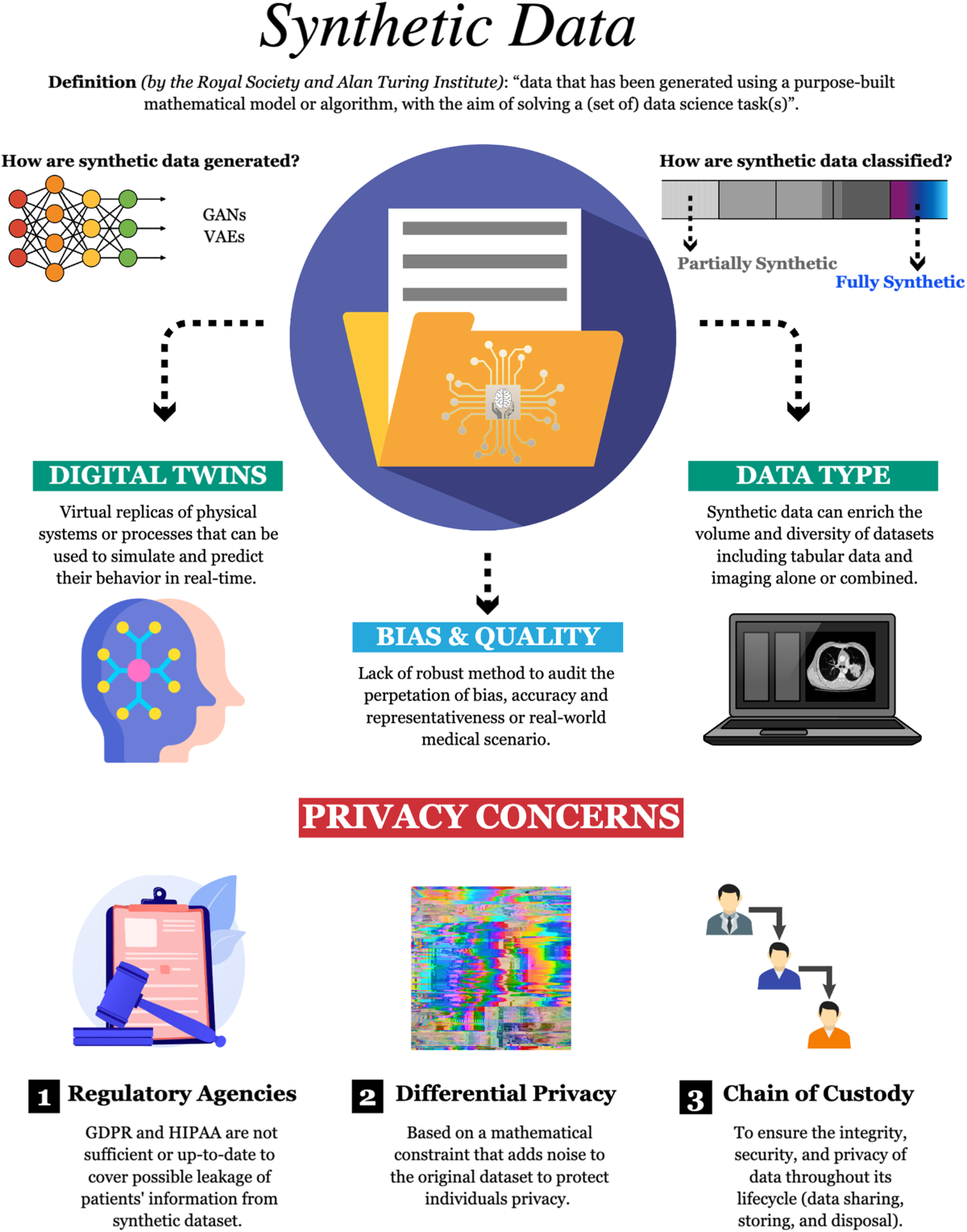
“Overview of synthetic data and its implications,” https://media.springernature.com/lw1200/springer-static/image/art%3A10.1038%2Fs41746-023-00927-3/MediaObjects/41746_2023_927_Fig1_HTML.png
M. Veeningen, B. de Weger, and N. Zannone, “Data minimisation in communication protocols: A formal analysis framework and application to identity management,” Int. J. Inf. Secur., vol. 13, no. 6, pp. 529–569, Apr. 2014.
M. S. Kiraz, “A comprehensive meta-analysis of cryptographic security mechanisms for cloud computing,” J. Ambient Intell. Humanized Comput., vol. 7, no. 5, pp. 731–760, Jun. 2016.
Z. Xiang, B. Ding, X. He, and J. Zhou, “Linear and range counting under metric-based local differential privacy,” in Proc. IEEE Int. Symp. Information Theory (ISIT), Los Angeles, CA, USA, 2020, pp. 908–913.
C. Troncoso, M. Isaakidis, G. Danezis, and H. Halpin, “Systematizing decentralization and privacy: Lessons from 15 years of research and deployments,” Proc. Privacy Enhancing Technol., vol. 2017, no. 4, pp. 404–426, Oct. 2017.
C. Chen et al., “Privacy computing meets metaverse: Necessity, taxonomy and challenges,” Ad Hoc Netw., vol. 158, p. 103457, May 2024.
J.-P. Stein, T. Messingschlager, T. Gnambs, F. Hutmacher, and M. Appel, “Attitudes towards AI: Measurement and associations with personality,” Sci. Rep., vol. 14, no. 1, Feb. 2024.
J. J. Sen, “Secure and privacy-preserving data aggregation protocols for wireless sensor networks,” in Cryptography and Security in Computing, J. Sen, Ed., 1st ed. Rijeka, Croatia: InTech Publishers, 2012, ch. 7, pp. 133–164.
Y. Liu et al., “Vertical federated learning: Concepts, advances, and challenges,” IEEE Trans. Knowl. Data Eng., pp. 1–20, Jan. 2024.
M. Hajian Berenjestanaki, H. R. Barzegar, N. El Ioini, and C. Pahl, “Blockchain-based e-voting systems: A technology review,” Electronics, vol. 13, no. 1, p. 17, Jan. 2024.
N. Tatipatri and S. L. Arun, “A comprehensive review on cyber-attacks in power systems: Impact analysis, detection and cybersecurity,” IEEE Access, pp. 1–1, Jan. 2024.
A. Azaria, R. Azoulay, and S. Reches, “ChatGPT is a remarkable tool—For experts,” Data Intell., vol. 6, no. 1, pp. 1–49, Nov. 2023.
P. Radanliev, “Frontier AI regulation: What form should it take?” Frontiers Polit. Sci., Mar. 2025.
X. Gu, F. Sabrina, Z. Fan, and S. Sohail, “A review of privacy enhancement methods for federated learning in healthcare systems,” Int. J. Environ. Res. Public Health, vol. 20, no. 15, p. 6539, Jan. 2023.
T. Mazhar et al., “Analysis of cyber security attacks and its solutions for the smart grid using machine learning and blockchain methods,” Future Internet, vol. 15, no. 2, p. 83, Feb. 2023.
J. Miao, C. Thongprayoon, S. Suppadungsuk, O. A. Garcia, and W. Cheungpasitporn, “Integrating retrieval-augmented generation with large language models in nephrology: Advancing practical applications,” Medicina, vol. 60, no. 3, p. 445, Mar. 2024.
A. Giannaros et al., “Autonomous vehicles: Sophisticated attacks, safety issues, challenges, open topics, blockchain, and future directions,” J. Cybersecurity Privacy, vol. 3, no. 3, pp. 493–543, 2023.
P. Budhwar et al., “Human resource management in the age of generative artificial intelligence: Perspectives and research directions on ChatGPT,” Hum. Resource Manag., vol. 33, no. 3, pp. 606–659, Jul. 2023.
M. Joshi, A. Pal, and M. Sankarasubbu, “Federated learning for healthcare domain: Pipeline, applications and challenges,” ACM Trans. Comput. Healthcare, vol. 3, no. 4, May 2022.
N. Sheybani, A. Ahmed, M. Kinsy, and F. Koushanfar, “Zero-knowledge proof frameworks: A systematic survey,” arXiv preprint, 2025.
J. Wei, Y. Chen, X. Yang, Y. Luo, and X. Pei, “A verifiable scheme for differential privacy based on zero-knowledge proofs,” J. King Saud Univ. Comput. Inf. Sci., vol. 37, no. 3, Apr. 2025.
R. Lavin, X. Liu, H. Mohanty, L. Norman, G. Zaarour, and B. Krishnamachari, “A survey on the applications of zero-knowledge proofs,” 2024.
R. A. Popa, A. J. Blumberg, H. Balakrishnan, and F. H. Li, “Privacy and accountability for location-based aggregate statistics,” Massachusetts Institute of Technology, Oct. 2011.
P. Khatiwada, B. Yang, J.-C. Lin, and B. Blobel, “Patient-generated health data (PGHD): Understanding, requirements, challenges, and existing techniques for data security and privacy,” J. Personalized Med., vol. 14, no. 3, p. 282, Mar. 2024.
Z. Amiri, A. Heidari, N. J. Navimipour, M. Esmaeilpour, and Y. Yazdani, “Deep learning applications in IoT-based bio- and medical informatics: A systematic literature review,” Neural Comput. Appl., Jan. 2024.
G. Yenduri et al., “GPT (Generative Pre-trained Transformer): A comprehensive review on enabling technologies, potential applications, emerging challenges, and future directions,” IEEE Access, vol. 12, pp. 1–1, Jan. 2024.
S. K. Jagatheesaperumal, K. Ahmad, A. Al-Fuqaha, and J. Qadir, “Advancing education through extended reality and Internet of Everything enabled metaverses: Applications, challenges, and open issues,” IEEE Trans. Learn. Technol., pp. 1–20, Jan. 2024.
M. D. Xames and T. G. Topcu, “A systematic literature review of digital twin research for healthcare systems: Research trends, gaps, and realization challenges,” IEEE Access, pp. 1–1, Jan. 2024.
V. Vimbi, N. Shaffi, and M. Mahmud, “Interpreting artificial intelligence models: A systematic review on the application of LIME and SHAP in Alzheimer’s disease detection,” Brain Informatics, vol. 11, no. 1, Apr. 2024.
J. Near, D. Darais, N. Lefkovitz, and G. Howarth, “Guidelines for evaluating differential privacy guarantees,” National Institute of Standards and Technology, Dec. 2023.
N. E. Bordenabe, K. Chatzikokolakis, and C. Palamidessi, “Optimal geo-indistinguishable mechanism s for location privacy,” in Proc. ACM SIGSAC Conf. Computer and Communications Security (CCS), Scottsdale, AZ, USA, 2014, pp. 251–262.